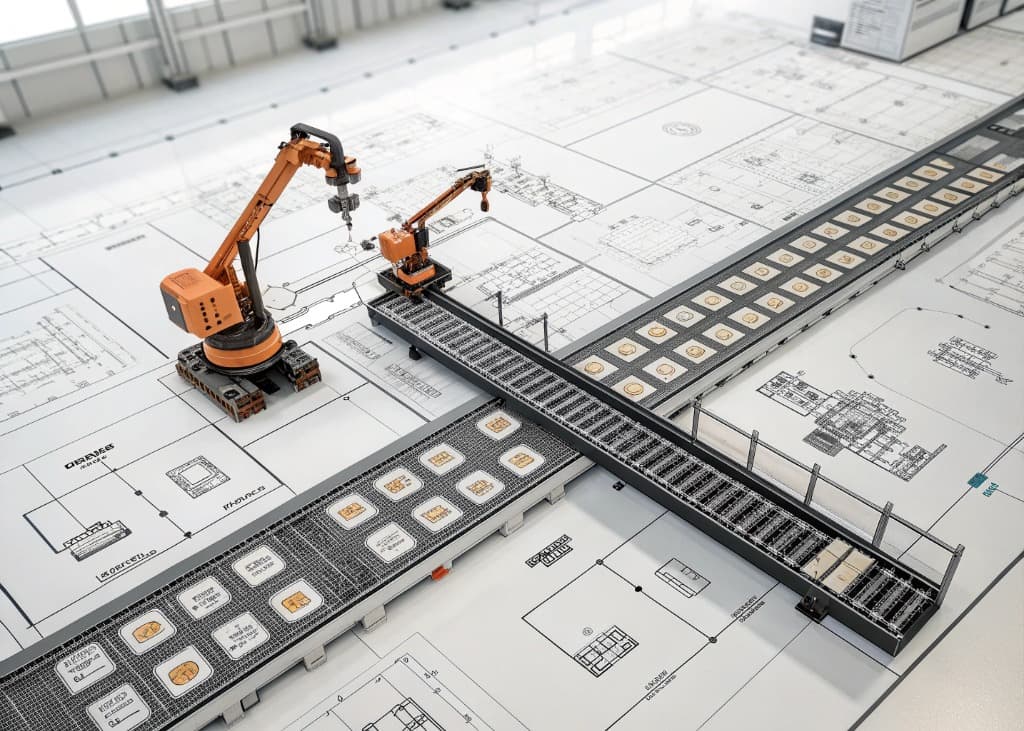
Most business owners spend 40% of their time moving data from email to CRM to spreadsheet. This is a waste of human potential. It is the digital equivalent of digging a ditch with a spoon when an excavator is parked in the driveway.
The Invisible Workforce
Here is what we see constantly: a business owner wakes up, checks emails, copies lead information into a spreadsheet, sends a follow-up email, updates their calendar, reminds themselves to check back in two days, and does this thirty times before lunch. Every day. Forever.
This is not working. This is clerical labour disguised as entrepreneurship. Every minute spent on data entry is a minute not spent closing deals, improving services, or building relationships that matter.
The solution is not hiring an assistant. It is building systems that handle repetitive tasks automatically, perfectly, and instantly. Welcome to the architecture of automation.
The 3-Step Loop That Runs Your Business
We build self-healing workflows that handle Lead Capture, Booking Confirmation, and Post-Service Nurture without you touching a keyboard. These are the three phases of every customer relationship, and each one can be automated.
Phase 1: Lead Capture and Instant Response
Speed to lead is everything. Research consistently shows that responding to leads within 5 minutes increases contact rates compared to 30-minute response times. If you do not reply in 5 minutes, your lead goes to a competitor who does.
Our automation workflows listen to your forms, emails, and missed calls. The second a signal comes in, the system wakes up and executes a sequence:
- Creates a contact in your CRM with all captured information
- Enriches the record with available data (company info, social profiles, previous interactions)
- Sends a personalized SMS or email reply within 60 seconds
- If high priority, triggers an AI voice agent to call and qualify immediately
- Notifies your team via Slack or text with full context
- Adds the lead to appropriate nurture sequences based on their inquiry
The lead receives immediate attention. They feel prioritized. They are already warming up to your business before you even know they exist. Meanwhile, your competitor is still checking their inbox.
Phase 2: The Booking Engine
Stop playing email tag. "Does Tuesday work?" "How about 2 PM?" "Actually, I have a conflict, can we do Wednesday?" This back-and-forth kills deals. It introduces friction at the exact moment when the prospect is ready to commit.
Our system sends a smart booking link that syncs with your real-time availability. The process is simple:
- Prospect receives a link showing your actual open slots
- They pick a time that works for both parties
- The system confirms the booking instantly
- Calendar events are added for both sides with video call links
- Reminder sequences trigger at 24 hours, 1 hour, and 15 minutes
- Pre-meeting intake forms collect necessary information automatically
What used to take 4-6 emails over multiple days now happens in under 30 seconds. No-show rates drop dramatically because of automated reminders. You spend zero time on scheduling logistics.
Phase 3: Nurture and Review Loop
The job is not done when the service is finished. In fact, the most valuable phase is what happens next. This is where you build repeat business and generate referrals.
The system waits for the job to be marked "Complete" in your workflow tool. Then it automatically triggers:
- A thank-you message with any relevant follow-up information
- A review request sequence (timed for optimal response)
- If they leave a 5-star review, an automated thank-you and referral request
- If they do not review, gentle follow-up reminders
- Addition to a long-term nurture sequence for repeat business
- Anniversary or seasonal check-ins to bring them back
Six months later, when they need your service again, they get a perfectly timed reminder. They book immediately through your automated system. The loop continues without you lifting a finger.
The Math of Automation
Let us do the actual calculation. Assume you spend 15 minutes per lead on administrative tasks: responding, scheduling, data entry, follow-up reminders. If you get 20 leads a week, that is 5 hours of administrative work.
At a conservative $50/hour for your time, that is $250 per week in hidden labour costs. That is $13,000 per year spent on tasks that could be instant and automatic.
But wait. It gets worse. What about the leads you lost because you were too slow? If even 2 leads per week went to competitors because of delayed response, and each lead was worth $500 on average, you lost $52,000 in annual revenue from response time alone.
Now consider the cost of automation: perhaps $500/month for tools and $2,000 for setup. ROI in the first year: well over 1000%. The software costs less than a single hour of your time per week.
Real Implementation: A Restaurant Case Study
A restaurant in Surrey came to us drowning in manual processes. They were copying reservation requests from Instagram DMs to a notebook, calling customers to confirm, and manually sending reminder texts. They missed reservations regularly. Customers complained about slow responses.
We built a simple automation stack:
- Online booking widget synced to their reservation system
- Auto-confirmation emails and SMS with table details
- 24-hour reminder with menu preview
- Post-visit feedback request
- Loyalty sequence for repeat visitors
Results after 90 days: reservation errors dropped to zero, repeat visit rate increased 34%, online reviews increased 4x, and the owner got 10 hours per week back. Total investment: less than one month of the previous inefficiency cost.
The Technology Stack
You do not need enterprise software. Modern automation uses accessible, affordable tools:
Workflow Orchestration: n8n, Make (formerly Integromat), or Zapier connect your applications and trigger actions based on events.
CRM: HubSpot, Pipedrive, or even Airtable can serve as your customer database where automation reads and writes.
Communication: Twilio for SMS, SendGrid for email, or integrated tools like Mailchimp that handle both.
Scheduling: Calendly, Acuity, or custom booking systems that sync with your calendar.
AI Enhancement: OpenAI or Claude for intelligent responses, classification, and content generation.
Our development team specializes in connecting these pieces into seamless systems tailored to your specific business.
Common Objections (And Why They Are Wrong)
"My customers want the personal touch."
Your customers want fast, accurate, reliable service. They do not care whether a human or a system sends their confirmation email. They care that they receive it within seconds of booking. Automation frees you to provide personal attention where it actually matters.
"My business is too unique for automation."
Your business is unique in its offerings and relationships. Your processes are not. Every business captures leads, schedules appointments, delivers services, and follows up. These patterns are universal and automatable.
"It sounds too complicated."
Modern automation tools are visual and intuitive. If you can create a flowchart on paper, you can build an automation. We handle the technical setup; your team manages simple modifications.
Getting Started
You do not need to automate everything at once. Start with the highest-impact, lowest-risk workflow:
- Map your current process: Write down every step for lead capture, booking, and follow-up
- Identify the bottleneck: Where do things get slow or fall through cracks?
- Automate one step: Start with instant lead response or automated booking
- Measure the impact: Track time saved and leads converted
- Expand from there: Add more automation as you see results
Each successful automation builds confidence and reveals the next opportunity. Within 90 days, you will wonder how you ever operated without it.
The Bottom Line
Workflow automation is not about replacing humans. It is about eliminating the work that humans should not be doing in the first place. Your expertise, creativity, and relationship-building skills are too valuable to waste on data entry and reminder emails.
The businesses that thrive in 2025 and beyond are those that build systems. They do not just work in their business; they work on their business. Automation is how you make that transition.
Ready to stop copy-pasting? Schedule a workflow audit and we will identify the three automations that would save you the most time immediately.