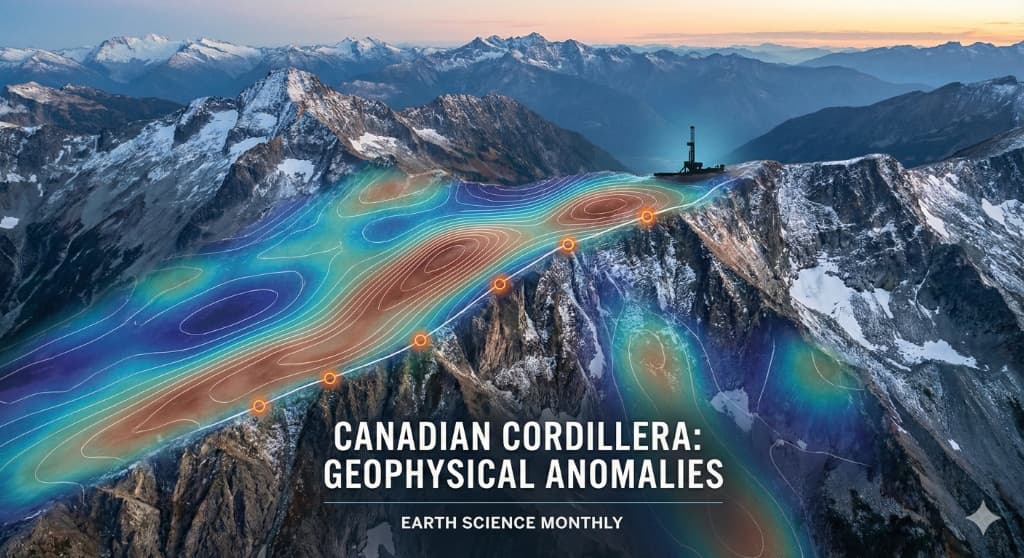
Quick Answer: AI in mineral exploration fuses geochemistry, geophysics, hyperspectral imagery, mapping and drill data into prospectivity models that rank targets with more discipline and less cost. Canada is pushing digital geoscience and AI adoption, from core scanning initiatives to open datasets that feed modern models.
Key Takeaways
- AI improves target ranking by learning mineralisation signatures from multi source datasets
- Hyperspectral satellites and core scanners add mineralogical detail that was hard to scale before
- Canada is investing in AI and critical minerals geoscience, which supports adoption in 2025
- Use AI as a decision aid, not a replacement for geologists. Model limits and sampling bias still matter
- Start thin. Fuse a few strong layers, validate on known ground, then expand
Why AI Matters Now in Mineral Exploration
Exploration teams face rising costs, scattered data, short field windows, and pressure to find critical minerals faster. The average discovery cost per major deposit has increased dramatically over the past two decades. Traditional methods are reaching their limits in mature exploration districts.
AI helps by ranking targets, flagging anomalies, and finding patterns across domains that are hard to see by eye. Success depends on data quality, geological hypotheses, and ruthless validation. The tech is ready, and the ecosystem in Canada is moving in the same direction.
The fundamental shift: instead of relying solely on expert interpretation of individual datasets, AI enables systematic integration of all available information. A geologist might look at magnetics separately from geochemistry. AI sees the relationships between them simultaneously across hundreds of thousands of data points.
What AI Actually Does in Exploration
1) Mineral Prospectivity Mapping
Prospectivity mapping is the core application. Models learn relationships between known deposits and predictor layers such as magnetics, radiometrics, structure density, alteration indices, and geochemical signatures. Output is a probability surface that guides boots on the ground.
The process works like this: you feed the AI examples of what successful mineralization looks like (positive training examples) and what barren ground looks like (negative examples). The model learns the multivariate signatures that distinguish them. Then it applies that learning across your entire project area to identify similar signatures in unexplored terrain.
Canadian studies have produced prospectivity maps that improve greenfield targeting. The key is treating the output as ranked hypotheses, not certainties. A high probability score means the area shares characteristics with known deposits. It does not guarantee mineralization.
2) Hyperspectral and Remote Sensing
Spaceborne and airborne hyperspectral sensors map alteration minerals across large areas. These sensors capture light across hundreds of narrow wavelength bands, revealing mineral signatures invisible to conventional cameras.
AI-based classifiers increase accuracy and consistency in interpreting this spectral data. Traditional interpretation requires expert spectroscopists. AI can process entire surveys with consistent methodology, flagging areas for expert review rather than requiring manual analysis of every pixel.
Recent work shows satellites like EnMAP can deliver mineralogical information suitable for exploration-scale decisions. This is valuable for early-stage screening: identify areas with alteration signatures before committing to expensive ground programs.
3) AI-Assisted Core and Chip Logging
Vision models and spectroscopy accelerate mineral identification, texture analysis, and veining frequency. Core logging is traditionally time-consuming and subject to variability between geologists. AI standardizes the process.
Canada has backed initiatives to apply AI to drill core archives and new campaigns. Scanning backlogs of historical core creates new datasets that can be integrated with modern exploration data. Patterns missed in original logging might be visible to AI analysis.
4) Data Fusion and Target Ranking
The strongest results come from fusing geophysics, geochemistry, structure, remote sensing, and geology into a single pipeline. Teams use model outputs as ranked hypotheses that field crews confirm or eliminate quickly.
Reviews across 2016 to 2025 show rapid progress in large-scale mineral prediction methods. The trend is toward end-to-end pipelines that take raw data through to ranked drill targets with full uncertainty quantification.
Canada Context for 2025
Canada's strategy emphasises digital technologies, safety, and environmental performance in mining and exploration. Federal programs support critical minerals geoscience, data initiatives, and AI-based workflows, including drill core scanning in the Northwest Territories.
This policy tailwind makes 2025 a practical year to systemise AI approaches rather than treat them as experiments. Government datasets are increasingly available. Funding programs recognize digital transformation as a priority. The infrastructure for AI-assisted exploration is maturing.
Our Approach at SLIME Media Solutions
We are designing AI-assisted exploration components that are modular and scalable. Our approach:
Public Components We Deliver:
- Dataset harmonisation templates for geochem, geophysics, structure, and remote sensing
- A thin prospectivity layer that ingests predictors and outputs ranked grids
- Early anomaly triage and report templates for field validation
- Governance rules for versioning, audit trails, and reproducibility
What We Keep Proprietary:
- Feature engineering recipes and thresholds
- Ensemble selection logic and weighting
- Region-specific priors, masks, and sampling corrections
- Custom target scoring linked to cost models
A Simple, Realistic Workflow
Step 1: Define the Mineral System
Document key processes and mappable footprints. What are you looking for? Orogenic gold? Porphyry copper? VMS? Each deposit type has characteristic signatures. Be specific about your target model before building AI systems.
Step 2: Assemble Predictors
Gather magnetics, gravity, radiometrics, DEM derivatives, lineament density, geochem indices, hyperspectral alteration maps, and geology polygons. Quality control is critical. Poor data leads to poor models.
Step 3: Train and Validate
Use deposits and prospects for labels where possible. Hold out areas for validation. Report lift curves and precision-recall metrics, not just accuracy. Accuracy is misleading when positive examples are rare.
Step 4: Rank Targets
Produce a probability map, cluster the high-probability zones, and filter by access and land constraints. Not every high-probability area is drillable. Practical constraints matter.
Step 5: Field Test and Iterate
Ground truth the top zones. Collect new data. Retrain the model with updated labels. This iterative loop is where AI compounds its value. Each field season makes the model smarter.
Risks, Limits, and How to Handle Them
Sampling Bias: Many datasets are denser near known deposits. The model may learn "proximity to roads" rather than "mineral signatures." Use spatial cross-validation and honest holdouts.
Garbage In, Garbage Out: Spend time on QC for geochem and sensor data before training. A model trained on inconsistent data produces inconsistent results.
Overconfident Maps: Share uncertainty bands and sensitivity tests. Stakeholders need to understand what the model does not know, not just what it predicts.
Human Factors: AI is a decision aid. Geologists remain in charge of hypotheses and field calls. The model suggests where to look. Humans decide what it means.
What to Watch in 2025
Better Satellite Mineralogy: More consistent hyperspectral retrievals at exploration scale improve early screening.
Core Archives at Scale: National and territorial programs begin scanning backlogs and applying AI to speed up interpretation.
Capital Following AI Explorers: Data-driven portfolios continue to attract funding and partnerships, pushing methods into new districts.
Policy Support for Critical Minerals: Canada maintains incentives and data investments that lower adoption barriers.
Quick Application Scenarios
Lithium in a Greenstone Belt: Fuse magnetics, structure density, radiometrics, and hyperspectral alteration to narrow LCT pegmatite corridors. Field crews then prioritise high-probability swarms for mapping and sampling.
Copper in a Porphyry Province: Use regional magnetics, gravity, mapped intrusions, lineaments, and alteration proxies to create a prospectivity surface. Run access and land constraints, then schedule IP over the top clusters.
Nickel in Mafic Intrusions: Combine gravity, magnetics, EM, and geochem ratios. AI helps translate geophysical textures into ranked conduit targets that justify scout drilling.
How We Can Help
- Build a thin, auditable pipeline that your geologists can trust
- Stand up a prospectivity workspace that ingests your datasets securely
- Produce decision reports with ranked targets, uncertainty notes, and next actions
- Hand over a governance guide for model versioning and reproducibility
You keep your data and domain knowledge. We bring disciplined pipelines and fast iteration. Learn more about our automation services or contact us to discuss your exploration challenges.
Conclusion
AI is not a magic wand. It is disciplined pattern finding that shortens the path from data to drill decision. If you are advancing projects in BC or anywhere in Canada, we can help you stand up a thin AI layer that pays its way.
Ready to modernize your exploration workflow? Book a confidential exploration workflow audit and we will map a practical plan for 2025.